- Go 81.5%
- JavaScript 15.1%
- Rust 2.2%
- Go Template 0.5%
- Makefile 0.3%
- Other 0.4%
 c22ce9ebb2
* feat(api): add OpenAPI v1 spec skeleton, lint ruleset and bundle tooling vacuum v0.30.6's `bundle --composed` mangles component names for this spec's multi-file layout (duplicates Problem as Problem__schemas etc.), so api-bundle uses the Redocly CLI (npx @redocly/cli bundle) instead. * fix(api): pin the Redocly CLI version Tried moving components out of the root document (per libopenapi's nested_files example) so vacuum's own bundler could produce clean names, but any component declared via $ref inside components.* still gets a __<parent>-suffixed twin regardless of collisions elsewhere, so vacuum's --composed bundler can't cleanly bundle this spec. Pin the already-working Redocly fallback to an exact version instead of @latest. * fix(api): bundle the OpenAPI spec with vacuum vacuum's --composed bundler suffixes any component reached via a $ref written directly inside the root document's own components.* block, regardless of collisions elsewhere. Dropping the root-level schemas/ parameters/responses declarations (keeping only securitySchemes, and leaving every component file under api/openapi/components/ untouched) lets vacuum bundle cleanly with no __ suffixes, going back to Go-only tooling. Components nothing references yet (ListMeta, offset, limit, BadRequest, Unauthorized, Forbidden, NotFound) are absent from the bundle until a later task's operation references them. * fix(api): make spec lint rules cover all schemas and error codes nd-schema-property-descriptions targeted $.components.schemas, but our schemas live in path/response files, not the root document, so it was dead code; switched to $..properties[*] to walk every resolved schema wherever it ends up. nd-error-responses-are-problems only checked a hardcoded status-code list; switched to a patternProperties schema matching the full 4xx/5xx range. Also: api-diff now diffs against the merge-base with API_DIFF_BASE (falling back to its tip with a notice if no merge-base exists), gen no longer depends on api-gen until Task 3 wires up oapi-codegen, and api-lint suppresses vacuum's banner. * feat(api): embed the bundled OpenAPI spec and expose its version * feat(api): generate the v1 server interface with oapi-codegen * feat(api): add RFC 9457 problem responses for API v1 * feat(api): add API v1 router with /server discovery and spec routes * fix(api): serve the OpenAPI document without range support * feat(api): mount API v1 behind the DevAPIv1 flag * chore(ci): lint, regenerate and diff the OpenAPI v1 spec * refactor(api): tighten spec version access, lint rules and test naming * refactor(api): simplify spec routes, tests and OpenAPI tooling Share one If-None-Match parser (utils/req) between the image and spec routes, declare the YAML spec response as an object so tests need no decoder override, and reuse ETag/304 spec components. Install the OpenAPI tools only when missing or at a different version, fail api-diff when its base ref does not exist, and in CI cache the tools, fold regeneration into the go generate check, and fetch only the PR base commit for the breaking-change gate. * refactor(api): raise the list limit maximum to 2000 and drop the flag test * feat(api): treat added enum values as non-breaking Enums in API v1 are open: clients must accept unknown values. api-diff now downgrades response-property-enum-value-added to INFO, while removing a value from a request enum stays breaking. * feat(api): gate breaking changes on x-stability-level Every operation declares x-stability-level (alpha, beta, stable). oasdiff ignores breaking changes to alpha operations and rejects lowering a level, so unreleased endpoints can evolve while beta and stable ones stay additive. All current operations start as alpha. * feat(api): declare loginMethods as an enum Prefix generated enum constants with their type name so enums sharing a value (for example password) cannot collide in package apiv1. * feat(api): send Allow on 405 and answer HEAD wherever GET is routed chi only sets Allow in its default 405 handler, so the problem-format handler now builds it by matching each method against the v1 router. HEAD requests fall back to the GET route, as RFC 9110 expects. * refactor(api): hash the spec ETag with xxh3 The bytes are compiled in, and the digest was truncated to 64 bits anyway, so this matches the artwork ETags instead of paying for cryptographic strength we discard. * docs(api): explain the about:blank problem type * feat(api): make code the problem identifier and omit a blank type RFC 9457 says clients switch on the type URI, but no adopter surveyed ships both a populated type and a separate code. Declare code as an enum, and send type only once a problem has semantics of its own. * fix(api): advertise the configured base path in the served OpenAPI spec With BaseURL=/music the API is mounted at /music/api/v1, but the spec told clients to call /api/v1 at the host root. The server now rewrites servers[0].url to BasePath + /api/v1 when it serves the document. Relative server URLs were tested first: "." and "../v1" work in openapi-generator, Swagger UI and Redoc, but Scalar resolves them against the page origin, so it breaks even without a base path. The committed bundle keeps /api/v1, and a test pins that it appears exactly once, which the rewrite relies on. |
||
|---|---|---|
| .devcontainer | ||
| .github | ||
| adapters | ||
| api | ||
| cmd | ||
| conf | ||
| consts | ||
| contrib | ||
| core | ||
| db | ||
| git | ||
| log | ||
| model | ||
| persistence | ||
| plugins | ||
| release | ||
| resources | ||
| scanner | ||
| scheduler | ||
| scripts | ||
| server | ||
| tests | ||
| ui | ||
| utils | ||
| .dockerignore | ||
| .git-blame-ignore-revs | ||
| .gitignore | ||
| .golangci.yml | ||
| .nvmrc | ||
| .octocov.yml | ||
| CODE_OF_CONDUCT.md | ||
| context7.json | ||
| CONTRIBUTING.md | ||
| Dockerfile | ||
| go.mod | ||
| go.sum | ||
| LICENSE | ||
| main.go | ||
| Makefile | ||
| Procfile.dev | ||
| README.md | ||
| reflex.conf | ||

Navidrome Music Server 








Navidrome is an open source web-based music collection server and streamer. It gives you freedom to listen to your music collection from any browser or mobile device. It's like your personal Spotify!
Note: The master branch may be in an unstable or even broken state during development.
Please use releases instead of
the master branch in order to get a stable set of binaries.
Check out our Live Demo!
Any feedback is welcome! If you need/want a new feature, find a bug or think of any way to improve Navidrome, please file a GitHub issue or join the discussion in our Subreddit. If you want to contribute to the project in any other way (ui/backend dev, translations, themes), please join the chat in our Discord server.
Installation
See instructions on the project's website
Cloud Hosting
PikaPods has partnered with us to offer you an officially supported, cloud-hosted solution. A share of the revenue helps fund the development of Navidrome at no additional cost for you.

Features
- Handles very large music collections
- Streams virtually any audio format available
- Reads and uses all your beautifully curated metadata
- Great support for compilations (Various Artists albums) and box sets (multi-disc albums)
- Multi-user, each user has their own play counts, playlists, favourites, etc...
- Very low resource usage
- Multi-platform, runs on macOS, Linux and Windows. Docker images are also provided
- Ready to use binaries for all major platforms, including Raspberry Pi
- Automatically monitors your library for changes, importing new files and reloading new metadata
- Supports lyrics from sidecar .ttml, .yaml/.yml Lyricsfile, .elrc, .lrc, .srt, .txt files and embedded TTML, Enhanced LRC, LRC, SRT, and plain-text tags (via
lyricspriority) - Themeable, modern and responsive Web interface based on Material UI
- Compatible with all Subsonic/Madsonic/Airsonic clients
- Transcoding on the fly. Can be set per user/player. Opus encoding is supported
- Translated to various languages
Translations
Navidrome uses POEditor for translations, and we are always looking for more contributors
Documentation
All documentation can be found in the project's website: https://www.navidrome.org/docs. Here are some useful direct links:
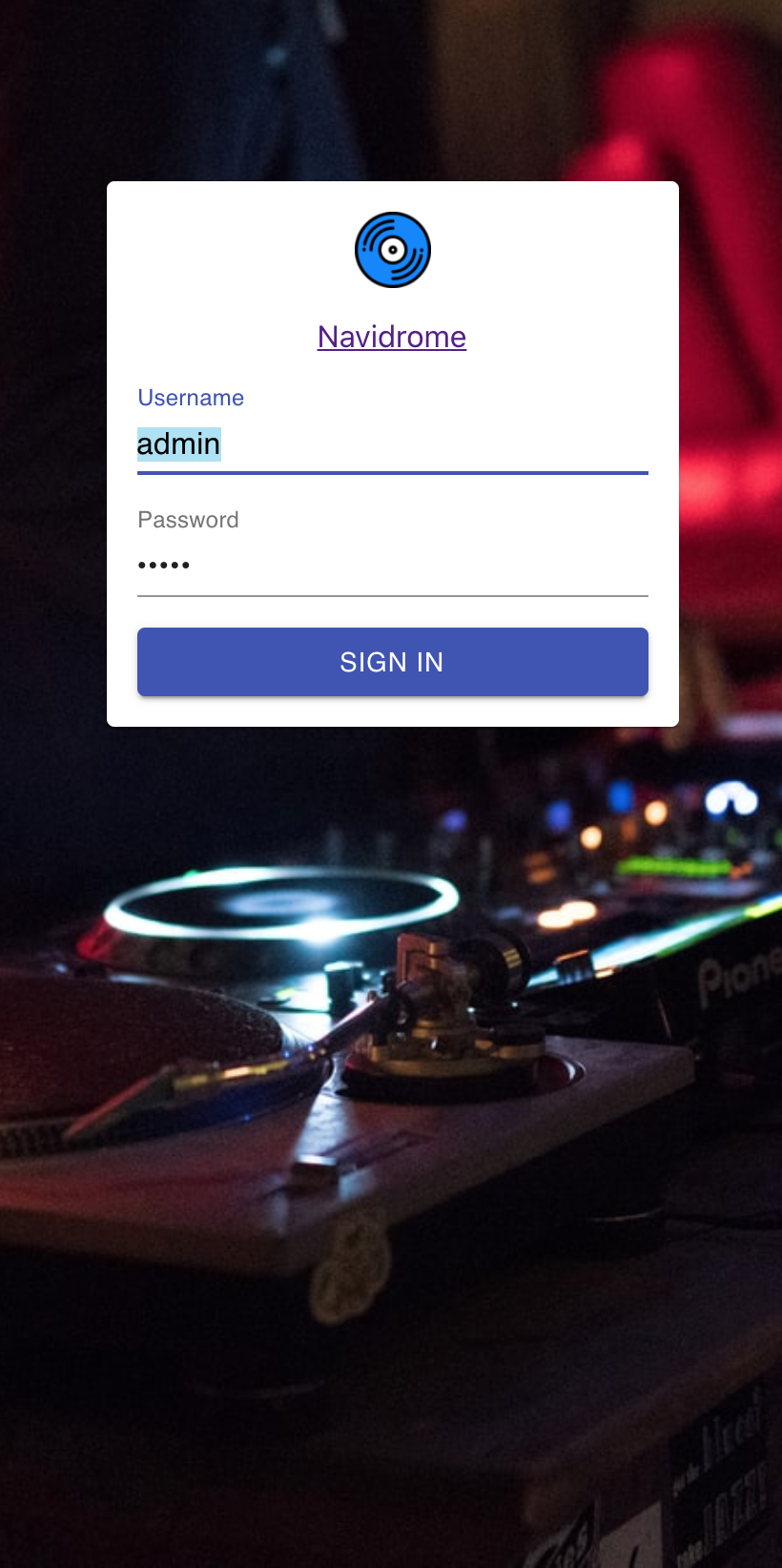
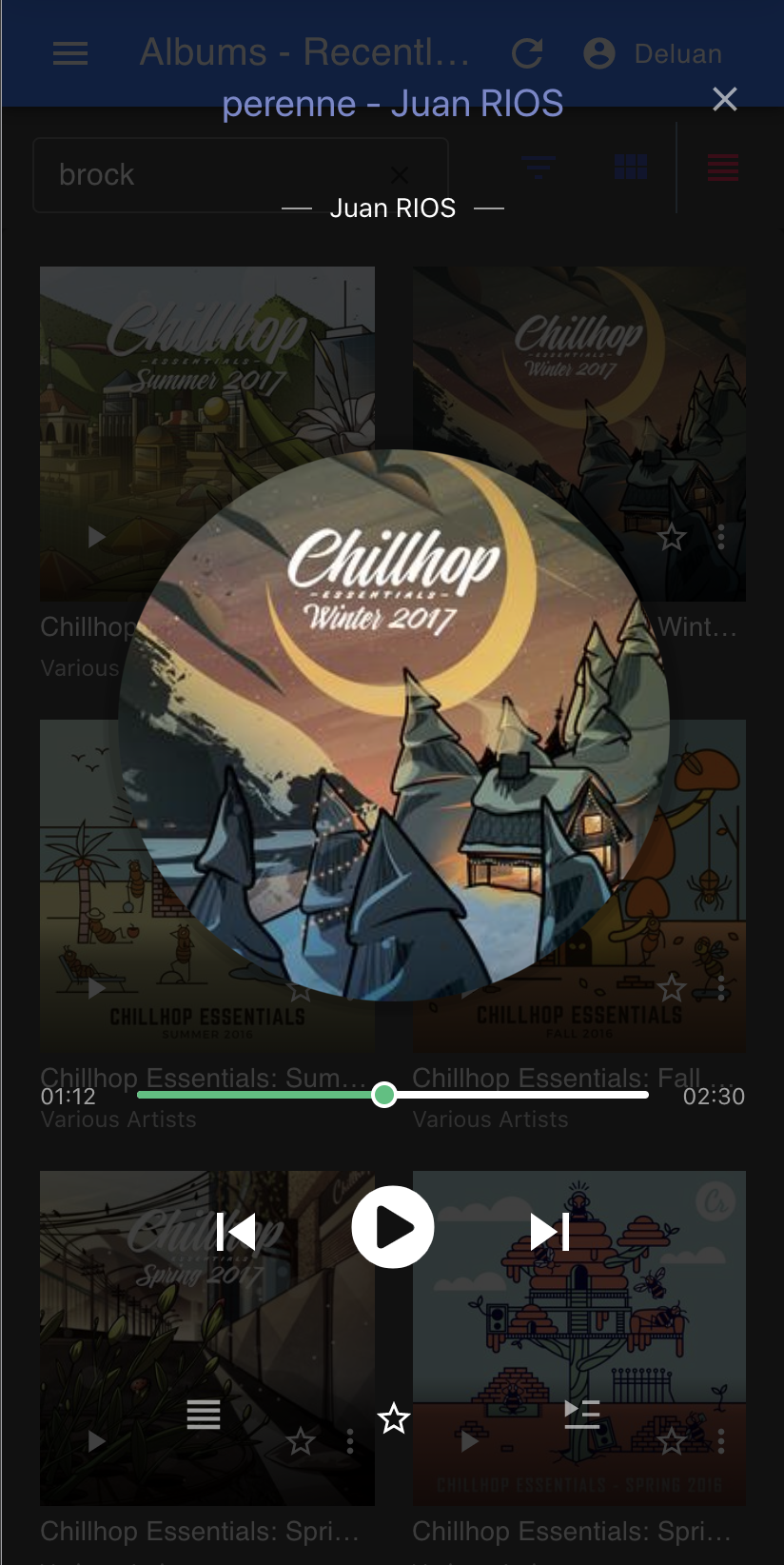
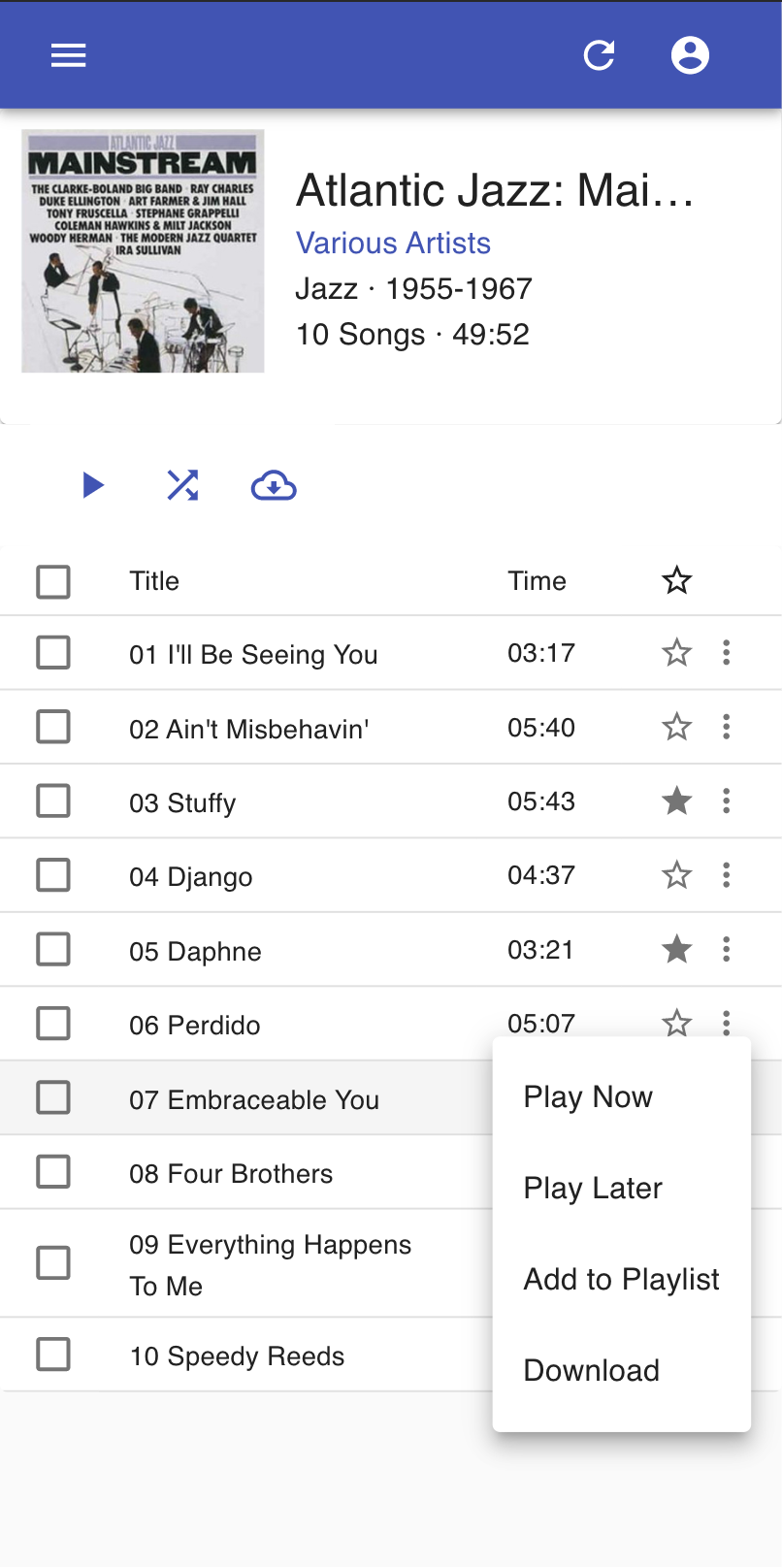
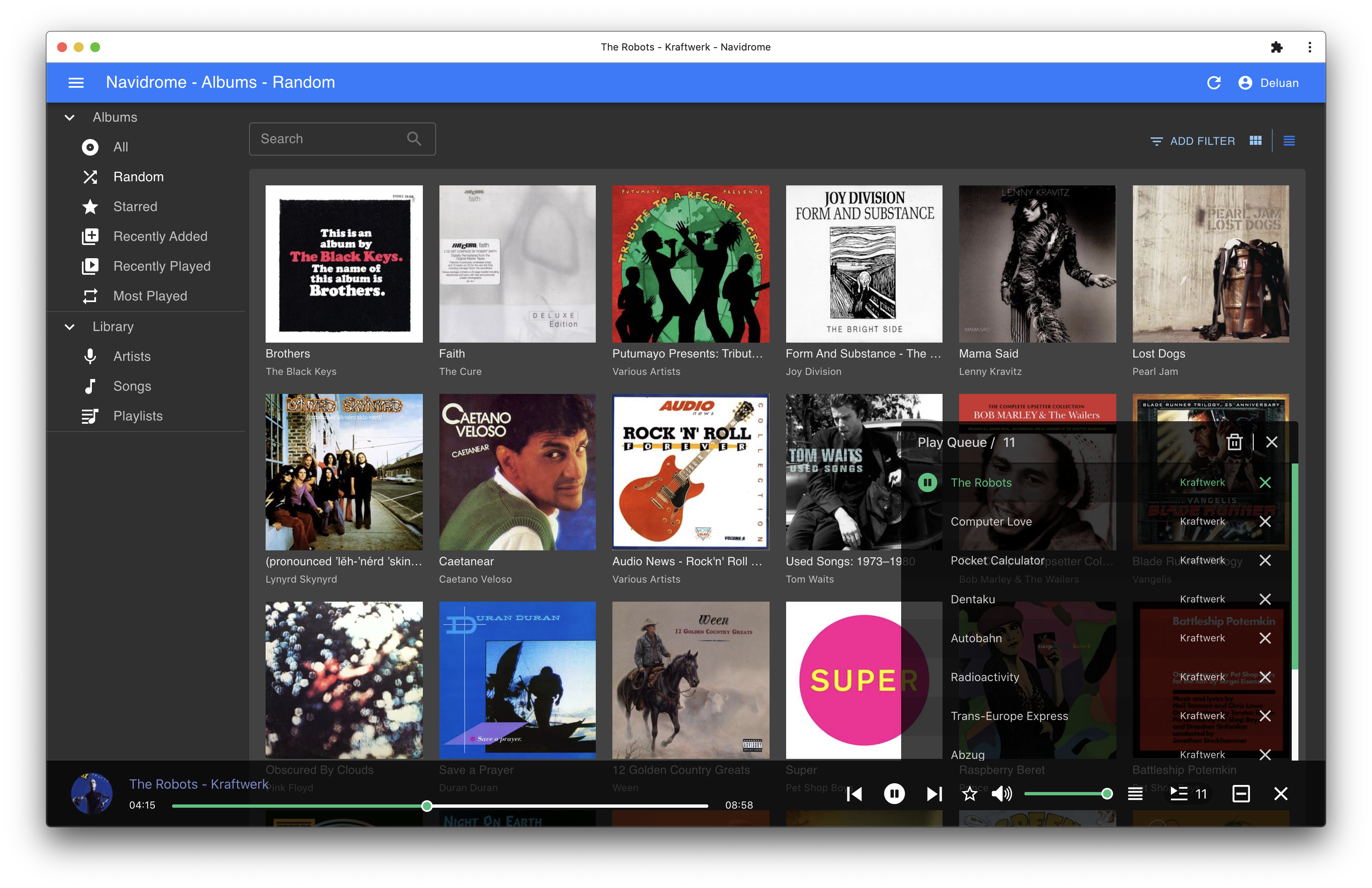
Screenshots