- Go 81.3%
- JavaScript 15.3%
- Rust 2.2%
- Go Template 0.5%
- Makefile 0.3%
- Other 0.4%
 c3b9b4ecb3
* fix(subsonic): limit failed authentication attempts per client IP and username The Subsonic API checked credentials on every request with no limit on failures, so any account could be brute-forced over /rest/*. Failed u+p, t+s and jwt attempts are now capped per (client IP, lower-cased username) using AuthRequestLimit and AuthWindowLength, the same settings that guard the UI login. Every request carries credentials, so only failures count: a slot is taken before the check and given back on success or on a server error, which also stops concurrent guesses from overshooting the limit. Blocked attempts get the same response as a wrong password (HTTP 200, error code 40, no Retry-After), so an attacker cannot tell a block from a wrong guess. Reverse proxy and internal authentication are not limited. The client IP helper behind ClientIPRateLimiter is now exported as server.ClientIP, so spoofed forwarding headers cannot open a fresh bucket. * refactor(subsonic): simplify failed authentication limiter Release the limiter slot from a single place in authenticate(), after the user lookup and credential check, instead of separately in the canceled branch. Store attempt counters by value instead of by pointer, and drop limiter unit tests that only repeated the middleware specs. * fix(subsonic): wait for an in-flight auth check instead of rejecting Slots were reserved before the credential check and only released afterwards, so once AuthRequestLimit checks for the same client IP and username overlapped, the next request was answered with error code 40 even when its credentials were valid. Clients that fan out parallel requests hit this constantly: a burst of six valid logins lost one, a burst of fifty lost forty five, and the web UI authenticates its own /rest calls the same way. A key now carries a slot channel of AuthRequestLimit capacity, and a request waits on it rather than failing when other checks for that key are in flight. Failures are recorded after the check, and a request is only rejected when the key already reached the limit within the window. A waiting request gives up if its context is canceled. Concurrent guesses still cannot run unchecked: at most AuthRequestLimit checks run at once and the rest are turned away as soon as the failures land. * docs(subsonic): state the real guess ceiling of the auth limiter The comment claimed a burst cannot overshoot, which reads as a hard cap of AuthRequestLimit. Allowing concurrent checks means a window admits up to 2*limit-1 guesses, so say that instead. |
||
|---|---|---|
| .devcontainer | ||
| .github | ||
| adapters | ||
| cmd | ||
| conf | ||
| consts | ||
| contrib | ||
| core | ||
| db | ||
| git | ||
| log | ||
| model | ||
| persistence | ||
| plugins | ||
| release | ||
| resources | ||
| scanner | ||
| scheduler | ||
| scripts | ||
| server | ||
| tests | ||
| ui | ||
| utils | ||
| .dockerignore | ||
| .git-blame-ignore-revs | ||
| .gitignore | ||
| .golangci.yml | ||
| .nvmrc | ||
| .octocov.yml | ||
| CODE_OF_CONDUCT.md | ||
| context7.json | ||
| CONTRIBUTING.md | ||
| Dockerfile | ||
| go.mod | ||
| go.sum | ||
| LICENSE | ||
| main.go | ||
| Makefile | ||
| Procfile.dev | ||
| README.md | ||
| reflex.conf | ||

Navidrome Music Server 








Navidrome is an open source web-based music collection server and streamer. It gives you freedom to listen to your music collection from any browser or mobile device. It's like your personal Spotify!
Note: The master branch may be in an unstable or even broken state during development.
Please use releases instead of
the master branch in order to get a stable set of binaries.
Check out our Live Demo!
Any feedback is welcome! If you need/want a new feature, find a bug or think of any way to improve Navidrome, please file a GitHub issue or join the discussion in our Subreddit. If you want to contribute to the project in any other way (ui/backend dev, translations, themes), please join the chat in our Discord server.
Installation
See instructions on the project's website
Cloud Hosting
PikaPods has partnered with us to offer you an officially supported, cloud-hosted solution. A share of the revenue helps fund the development of Navidrome at no additional cost for you.

Features
- Handles very large music collections
- Streams virtually any audio format available
- Reads and uses all your beautifully curated metadata
- Great support for compilations (Various Artists albums) and box sets (multi-disc albums)
- Multi-user, each user has their own play counts, playlists, favourites, etc...
- Very low resource usage
- Multi-platform, runs on macOS, Linux and Windows. Docker images are also provided
- Ready to use binaries for all major platforms, including Raspberry Pi
- Automatically monitors your library for changes, importing new files and reloading new metadata
- Supports lyrics from sidecar .ttml, .yaml/.yml Lyricsfile, .elrc, .lrc, .srt, .txt files and embedded TTML, Enhanced LRC, LRC, SRT, and plain-text tags (via
lyricspriority) - Themeable, modern and responsive Web interface based on Material UI
- Compatible with all Subsonic/Madsonic/Airsonic clients
- Transcoding on the fly. Can be set per user/player. Opus encoding is supported
- Translated to various languages
Translations
Navidrome uses POEditor for translations, and we are always looking for more contributors
Documentation
All documentation can be found in the project's website: https://www.navidrome.org/docs. Here are some useful direct links:
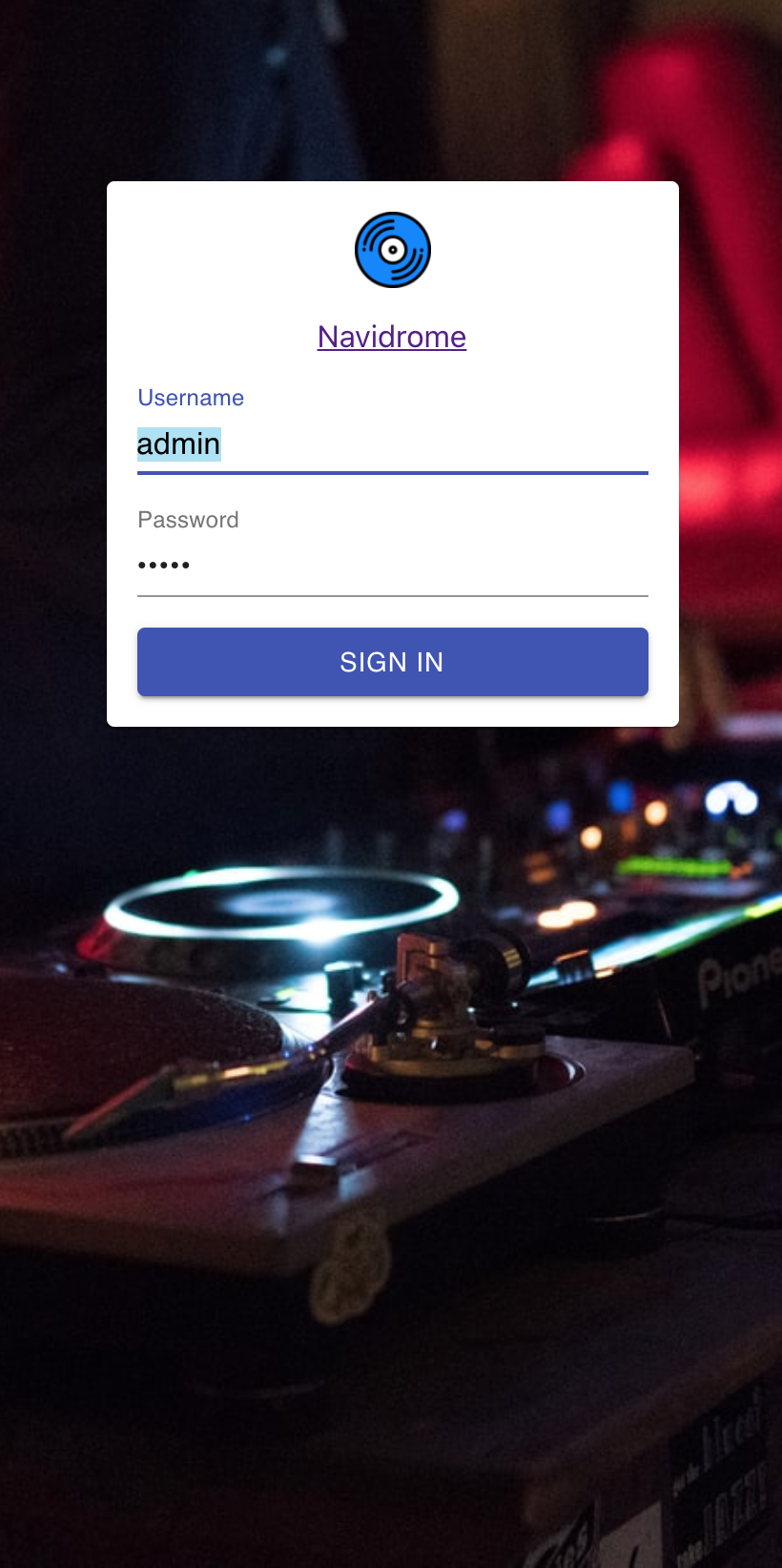
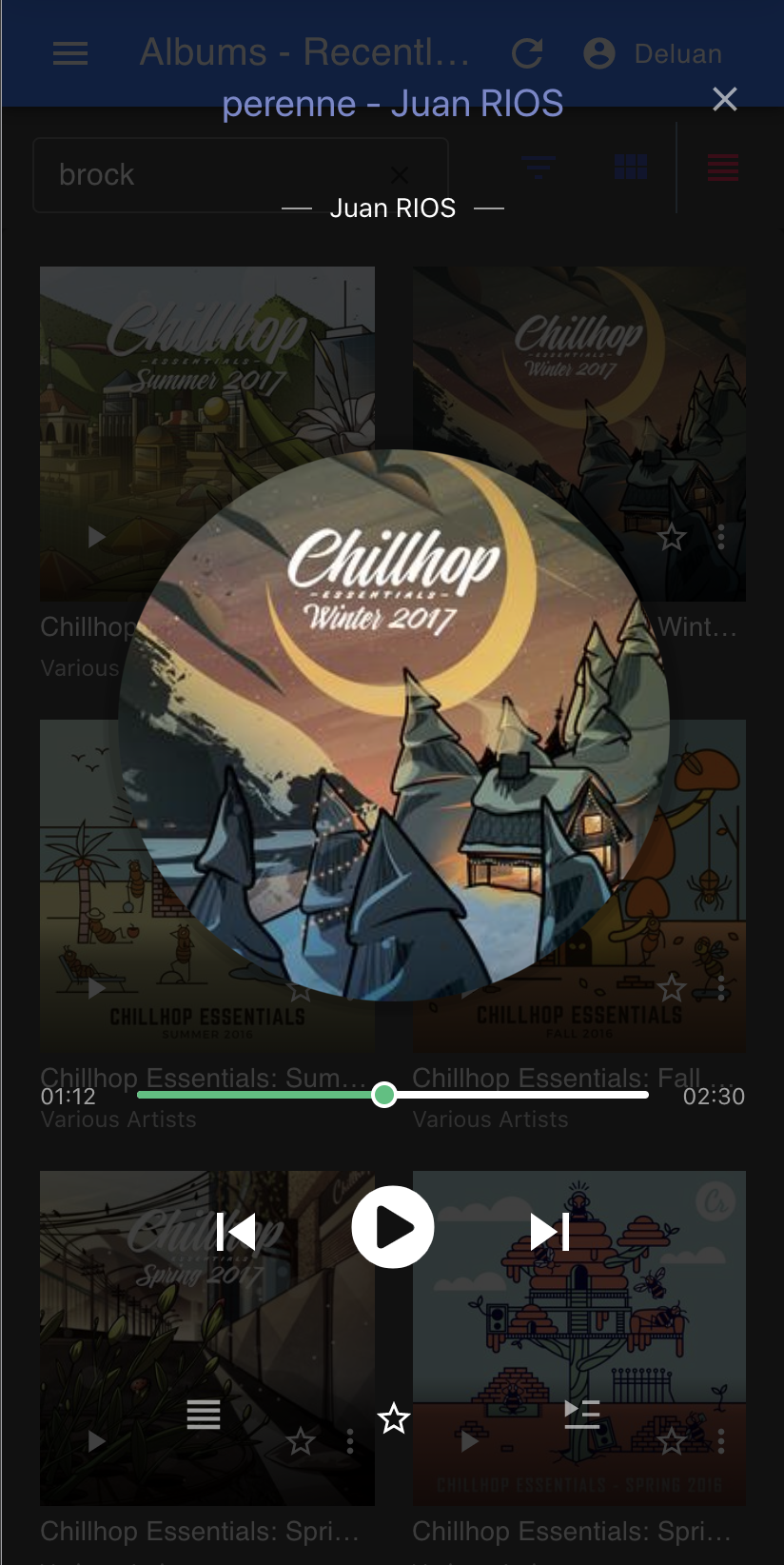
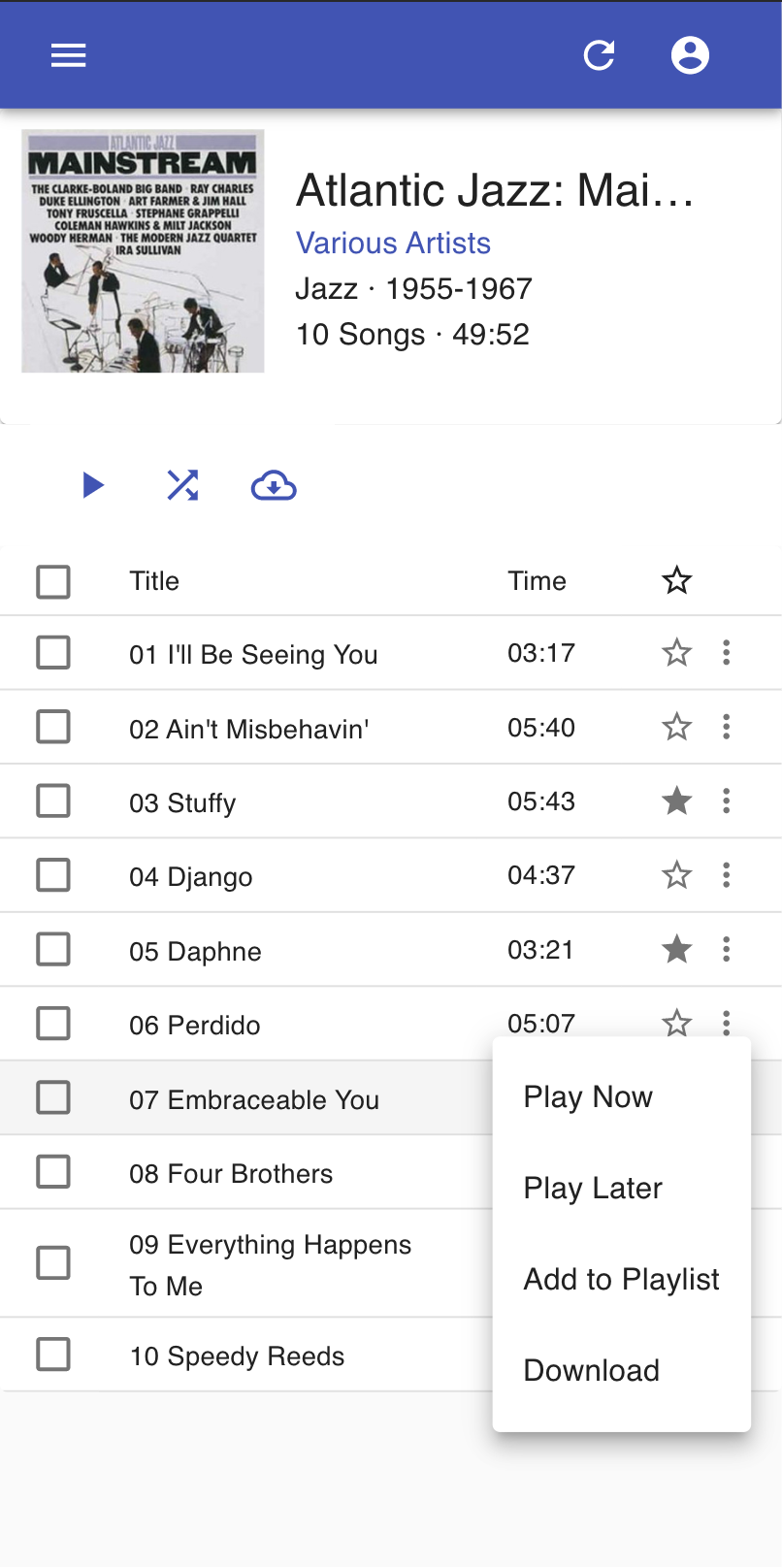
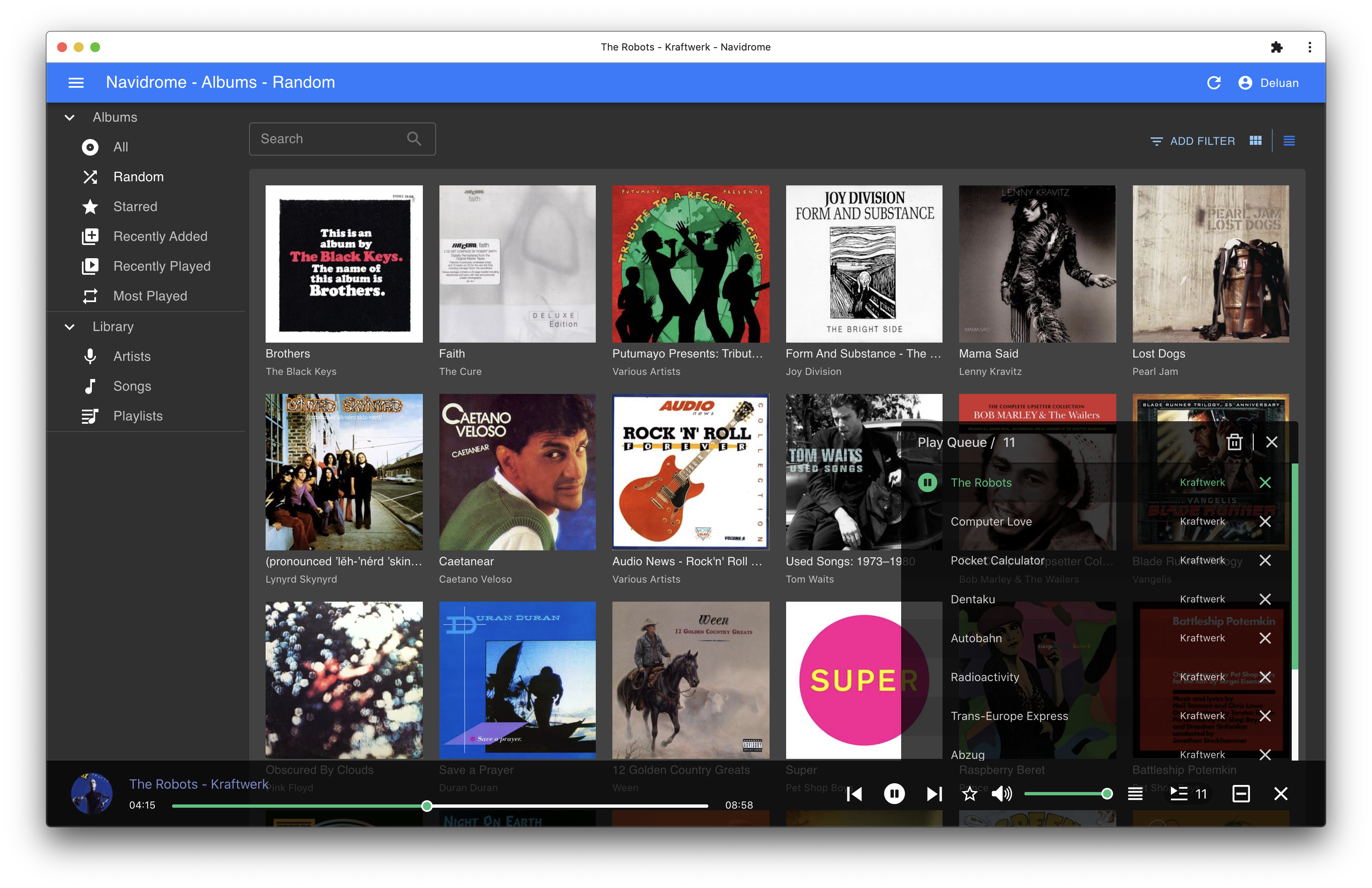
Screenshots