- Go 81.5%
- JavaScript 15.1%
- Rust 2.2%
- Go Template 0.5%
- Makefile 0.3%
- Other 0.4%
 fed35e08de
* feat(jellyfin): compute the address advertised by auto-discovery * fix(jellyfin): use TLSEnabled and path.Join for the auto-discovery address * feat(jellyfin): answer LAN auto-discovery broadcasts * test(jellyfin): e2e check that auto-discovery matches the public server identity * feat(jellyfin): add opt-in AutoDiscovery option and start the listener * fix(jellyfin): close the auto-discovery socket on read errors and quiet reply failures * refactor(jellyfin): build the auto-discovery address with publicurl and log bind failures in place discoveryAddress now hands only the discovery-specific part (the requester-facing host) to publicurl.AbsoluteURL, so the BaseURL, scheme and BasePath rules live in one place. ServeDiscovery logs its own bind failure and returns nothing, so the caller cannot route the error into the server errgroup. Tests use a DescribeTable and no longer wait on a fixed timeout to prove a packet was ignored. * refactor(jellyfin): run auto-discovery as its own service in the main errgroup Discovery is now a small type that needs only a DataStore, started by startJellyfinDiscovery like the other background services, so the errgroup waits for it on shutdown and startServer is back to a one-line mount. The server id resolution moved to resolveServerID with a package-level lock: the Router and Discovery are separate objects, and a per-Router lock would let them persist two different ids on first boot. * refactor(jellyfin): build Discovery through wire and drop the serverName forwarder startJellyfinDiscovery now follows its siblings: negative guard with a DISABLED debug log, and the service comes from a CreateJellyfinDiscovery wire injector instead of an inline constructor. The Router.serverName method only forwarded to the package function, so its four call sites call the function directly. * fix(jellyfin): skip auto-discovery for unix socket servers without a BaseURL host With Address set to a unix socket nothing listens on Port, so the route-facing IP plus Port pointed clients at a dead URL. Discovery now logs a warning and does not start in that mode unless BaseURL names the proxy host, which AbsoluteURL already advertises as-is. * docs(jellyfin): note which address auto-discovery advertises on restricted binds Also stop using a hostname Address in the fallback spec: a hostname like localhost binds a single interface, so it is not an example of the route-facing fallback being right. An empty Address is. |
||
|---|---|---|
| .devcontainer | ||
| .github | ||
| adapters | ||
| cmd | ||
| conf | ||
| consts | ||
| contrib | ||
| core | ||
| db | ||
| git | ||
| log | ||
| model | ||
| persistence | ||
| plugins | ||
| release | ||
| resources | ||
| scanner | ||
| scheduler | ||
| scripts | ||
| server | ||
| tests | ||
| ui | ||
| utils | ||
| .dockerignore | ||
| .git-blame-ignore-revs | ||
| .gitignore | ||
| .golangci.yml | ||
| .nvmrc | ||
| .octocov.yml | ||
| CODE_OF_CONDUCT.md | ||
| context7.json | ||
| CONTRIBUTING.md | ||
| Dockerfile | ||
| go.mod | ||
| go.sum | ||
| LICENSE | ||
| main.go | ||
| Makefile | ||
| Procfile.dev | ||
| README.md | ||
| reflex.conf | ||

Navidrome Music Server 








Navidrome is an open source web-based music collection server and streamer. It gives you freedom to listen to your music collection from any browser or mobile device. It's like your personal Spotify!
Note: The master branch may be in an unstable or even broken state during development.
Please use releases instead of
the master branch in order to get a stable set of binaries.
Check out our Live Demo!
Any feedback is welcome! If you need/want a new feature, find a bug or think of any way to improve Navidrome, please file a GitHub issue or join the discussion in our Subreddit. If you want to contribute to the project in any other way (ui/backend dev, translations, themes), please join the chat in our Discord server.
Installation
See instructions on the project's website
Cloud Hosting
PikaPods has partnered with us to offer you an officially supported, cloud-hosted solution. A share of the revenue helps fund the development of Navidrome at no additional cost for you.

Features
- Handles very large music collections
- Streams virtually any audio format available
- Reads and uses all your beautifully curated metadata
- Great support for compilations (Various Artists albums) and box sets (multi-disc albums)
- Multi-user, each user has their own play counts, playlists, favourites, etc...
- Very low resource usage
- Multi-platform, runs on macOS, Linux and Windows. Docker images are also provided
- Ready to use binaries for all major platforms, including Raspberry Pi
- Automatically monitors your library for changes, importing new files and reloading new metadata
- Supports lyrics from sidecar .ttml, .yaml/.yml Lyricsfile, .elrc, .lrc, .srt, .txt files and embedded TTML, Enhanced LRC, LRC, SRT, and plain-text tags (via
lyricspriority) - Themeable, modern and responsive Web interface based on Material UI
- Compatible with all Subsonic/Madsonic/Airsonic clients
- Transcoding on the fly. Can be set per user/player. Opus encoding is supported
- Translated to various languages
Translations
Navidrome uses POEditor for translations, and we are always looking for more contributors
Documentation
All documentation can be found in the project's website: https://www.navidrome.org/docs. Here are some useful direct links:
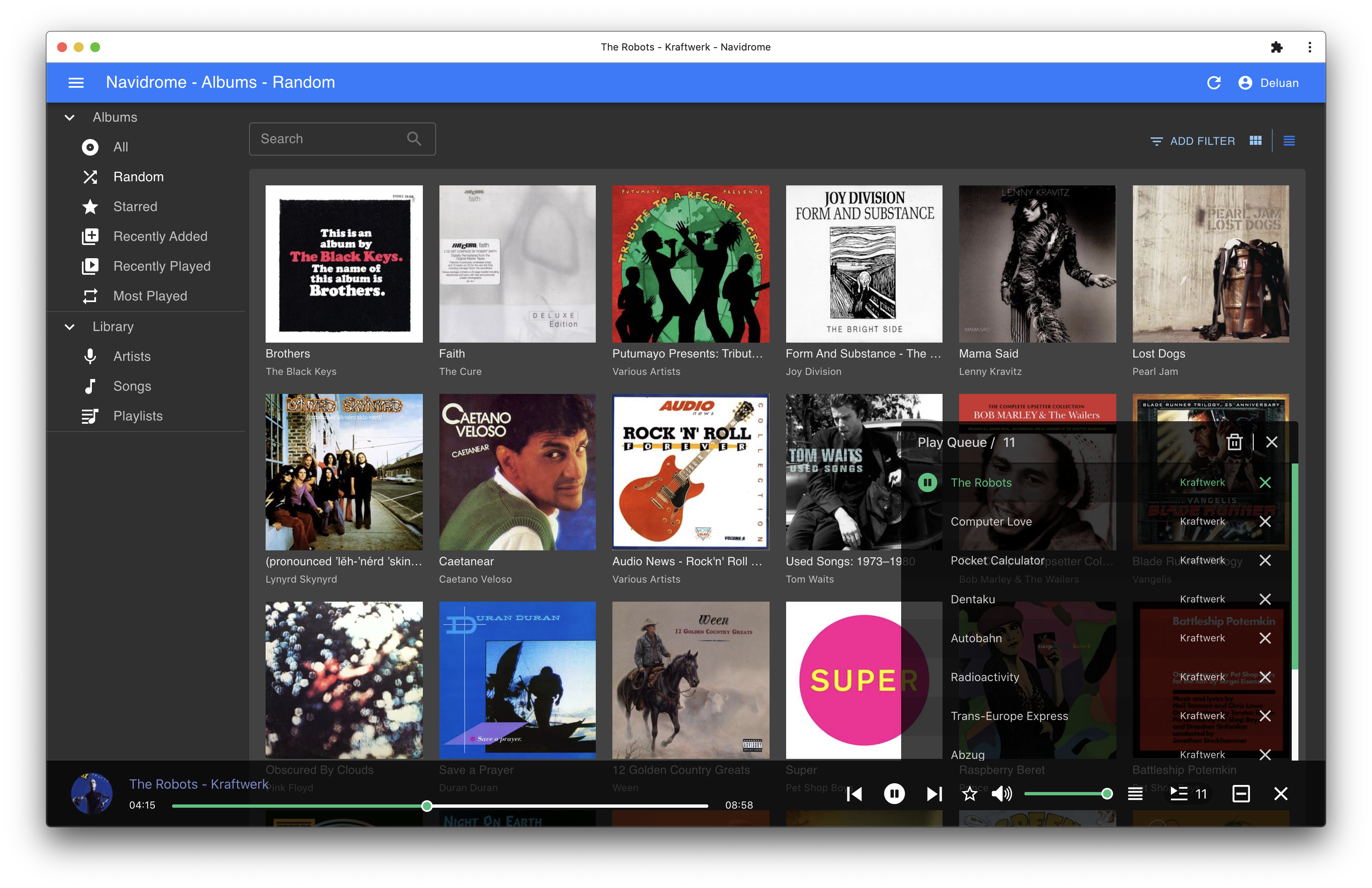
Screenshots