mirror of
https://github.com/basnijholt/adaptive-lighting.git
synced 2026-09-18 09:44:05 +02:00
 cbbcabdd1f
* Add documentation site with Zensical framework
Create comprehensive documentation site for adaptive-lighting.nijho.lt:
- Add zensical.toml configuration with Material theme (amber/orange)
- Create docs_gen.py module for extracting README sections via markers
- Add section markers to README.md for content reuse
- Create documentation pages:
- index.md: Home with features overview
- getting-started.md: Installation and quick setup
- configuration.md: Auto-generated config options table
- services.md: Auto-generated service documentation
- automation-examples.md: Real-world automation recipes
- troubleshooting.md: Common issues and solutions
- see-also.md: External resources and links
- advanced/brightness-modes.md: Brightness mode deep dive
- advanced/manual-control.md: Manual control system docs
- advanced/sleep-mode.md: Sleep mode configuration
- Add GitHub Actions workflow for building and deploying to Pages
- Add custom CSS with sun-themed styling
- Add CNAME for custom domain
Uses markdown-code-runner to auto-generate content from code schemas
and extract README sections for single-source documentation.
* [pre-commit.ci] auto fixes from pre-commit.com hooks
for more information, see https://pre-commit.ci
* Remove duplicated content from docs, make pages thin wrappers
- troubleshooting.md: Remove manually written "Additional Tips" section
- automation-examples.md: Remove duplicate "Additional Examples" section
- configuration.md: Remove duplicate "Option Categories" tables
- sleep-mode.md: Simplify to reference main config, remove duplicate examples
- docs_gen.py: Remove unused get_troubleshooting() and get_sleep_mode_intro()
This reduces duplication risk by keeping README as single source of truth.
Docs pages now primarily pull content via markdown-code-runner.
* [pre-commit.ci] auto fixes from pre-commit.com hooks
for more information, see https://pre-commit.ci
* Integrate webapp (simulator) into docs workflow
- Merge deploy-webapp.yml into docs.yml workflow
- Build simulator and place at /simulator/ subdirectory
- Update docs links to use relative paths to simulator
- Remove separate deploy-webapp.yml to avoid conflicts
The combined workflow now:
1. Builds docs with zensical
2. Builds webapp with shinylive
3. Copies webapp to site/simulator/
4. Deploys everything to GitHub Pages
Simulator will be at adaptive-lighting.nijho.lt/simulator/
* Fix pre-commit and CI issues
- Add site_name to zensical.toml (required by MkDocs)
- Fix RET504 in docs_gen.py (unnecessary assignment before return)
- Remove docs/run_markdown_code_runner.py (lint issues, not needed for CI)
* Fix _docs_helpers.py import error in CI
- Add try/except for relative vs absolute imports in _docs_helpers.py
- Remove silent error handling in docs workflow (fail on error)
The relative import fails when markdown-code-runner executes the code
directly via sys.path.insert. The fallback to absolute import fixes this.
* Temporarily enable deployment from feature branch
* Add tabulate dependency for pandas to_markdown()
* Fix theme configuration for proper light/dark mode
- Restructure zensical.toml to match working agent-cli config
- Add three-way palette toggle (system/light/dark)
- Use proper [project.theme] structure
- Simplify extra.css to not override theme colors
- Add Inter font for text, JetBrains Mono for code
* Add Plausible analytics and fix homepage navigation
- Add custom analytics override for plausible.nijho.lt tracking
- Remove hide:navigation from index.md to show menu on homepage
* Remove temporary feature branch deployment settings
Revert to main-only deployment for docs workflow before merging.
* Revert "Remove temporary feature branch deployment settings"
This reverts commit c568694837.
* Add markdown-gfm-admonition for GitHub-style admonitions
The zensical build was failing silently because gfm_admonition extension
was not installed. Add the dependency to pyproject.toml and docs workflow.
* Use uv sync for documentation dependencies
Switch from manual pip installs to uv sync with pyproject.toml for cleaner
dependency management and reproducible builds.
* Fix markdown rendering inside details blocks
Enable md_in_html extension and add markdown="1" attribute to <details>
tags so markdown content inside them is properly rendered.
* Remove emojis from manually written documentation
Keep emojis in auto-generated content from README, but remove from
manually maintained docs in favor of clean text and Material icons.
* Enable attr_list extension for button styling
* Improve pyproject.toml and use GitHub-style admonitions
- Add accurate project metadata (version, authors, classifiers, URLs)
- Organize dependency groups: docs, dev, test
- Add tool configs for ruff, mypy, pytest
- Convert MkDocs-style admonitions (!!! tip) to GitHub-style (> [!TIP])
- Use docs group in CI workflow
* Add homeassistant and ulid-transform as runtime dependencies
Remove speculative test dependencies since tests run inside HA core.
* Simplify docs_gen.py - remove wrapper functions
Use readme_section() directly in docs instead of 10 one-liner wrappers.
Changed default strip_heading to True since that's the common case.
* Populate empty OUTPUT sections with markdown-code-runner
* Add markdown-code-runner workflow for auto-updating docs
- Add docs/run_markdown_code_runner.py script to process all docs
- Add GitHub workflow to run on push/PR and auto-commit changes
* Exclude README.md from markdown-code-runner workflow
README.md contains code blocks that import from
homeassistant.components.adaptive_lighting, which only exists
when running inside Home Assistant core, not in a regular venv.
* Update auto-generated docs
* Use editable install for markdown-code-runner workflow
- Add setuptools.packages.find config pointing to custom_components
- Remove sys.path.insert manipulation from all docs files
- Update imports to use adaptive_lighting.* package paths
- Install package with `uv pip install -e .` in workflow
- Remove deprecated license classifier (PEP 639)
* Consolidate markdown-code-runner into single workflow
- Remove separate markdown-code-runner.yml workflow
- Update update-readme.yml to handle all markdown files (docs + README)
- Rename workflow to "Update auto-generated content"
- Update README imports to use adaptive_lighting package path
* Rename workflow to markdown-code-runner
* Remove accidentally committed files
* Remove redundant markdown-code-runner from docs workflow
* Fix: use uv pip install instead of uv add in CI
* Add webapp deps (astral, shinylive) to docs group
* Remove unused install_dependencies action
* Update to latest action versions (uv@v5, upload-pages-artifact@v4)
* Remove try/except import fallback in _docs_helpers.py
* Restore install_dependencies action (used by pytest)
* Simplify docs workflow: run on all pushes/PRs
* Simplify mcr workflow paths; revert install_dependencies to main
* Remove redundant cp+sed for webapp (file already in repo)
* Fix mcr push: pull --rebase before push
* Fix mcr: checkout PR branch instead of detached HEAD
* Update auto-generated content
* Switch from setuptools to hatch build system
Replace [tool.setuptools.packages.find] with [tool.hatch.build.targets.wheel]
for hatchling compatibility.
* Update auto-generated content
* Move homeassistant deps to docs group
This is a HA custom component, not a pip package. The homeassistant
dependency is only needed for docs building, not as a project dependency.
* Update auto-generated content
* Remove PyPI-only metadata from pyproject.toml
* Remove arbitrary version constraints from dependency groups
* Update auto-generated content
* Remove unused troubleshooting section markers from README
* Remove temporary feature branch settings from docs workflow
* Use GitHub admonition syntax for warning in change_switch_settings section
* Update auto-generated content
124 lines
5.7 KiB
Markdown
124 lines
5.7 KiB
Markdown
---
|
|
icon: lucide/trending-up
|
|
---
|
|
|
|
# Brightness Modes
|
|
|
|
Enhance your control over brightness transitions during sunrise and sunset with the `brightness_mode` option.
|
|
|
|
## Available Modes
|
|
|
|
Adaptive Lighting supports three brightness modes:
|
|
|
|
| Mode | Description |
|
|
|------|-------------|
|
|
| `default` | Standard behavior based on sun position |
|
|
| `linear` | Linear ramp between min/max brightness |
|
|
| `tanh` | Smooth S-curve using hyperbolic tangent |
|
|
|
|
## Detailed Explanation
|
|
|
|
<!-- CODE:START -->
|
|
<!-- from adaptive_lighting.docs_gen import readme_section -->
|
|
<!-- print(readme_section("brightness-modes")) -->
|
|
<!-- CODE:END -->
|
|
<!-- OUTPUT:START -->
|
|
<!-- ⚠️ This content is auto-generated by `markdown-code-runner`. -->
|
|
<details markdown="1">
|
|
<summary>Enhance your control over brightness transitions during sunrise and sunset with <code>brightness_mode</code> (click here to learn more 🧠).</summary>
|
|
|
|
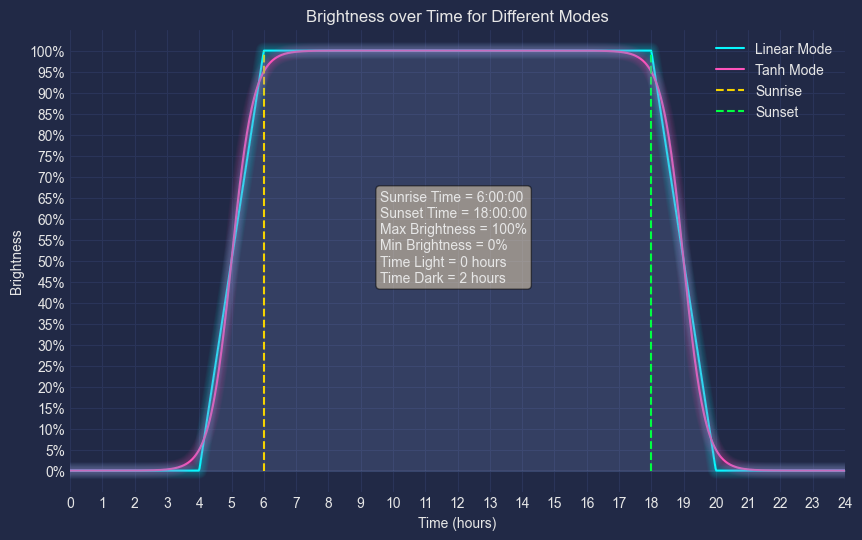
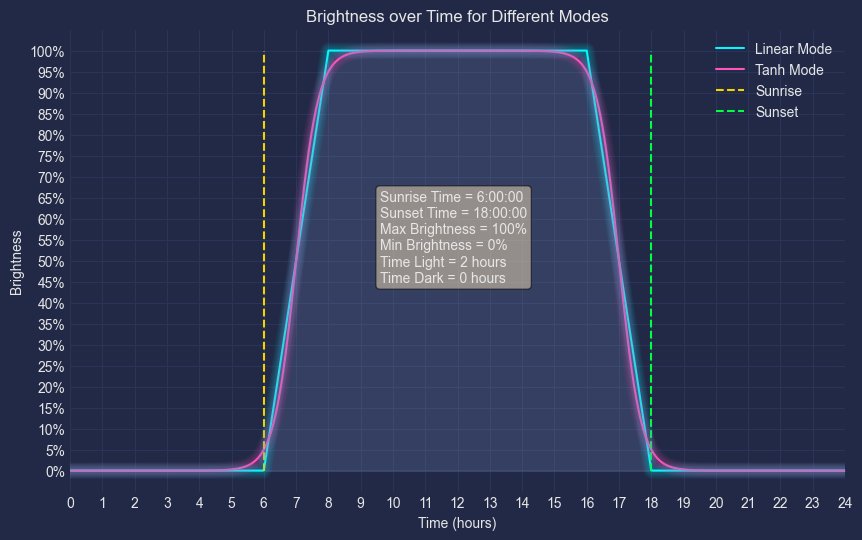
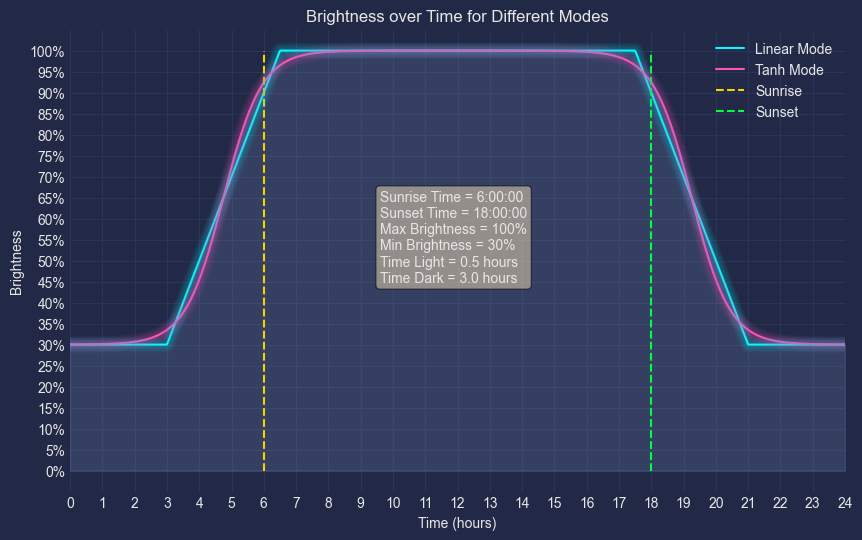
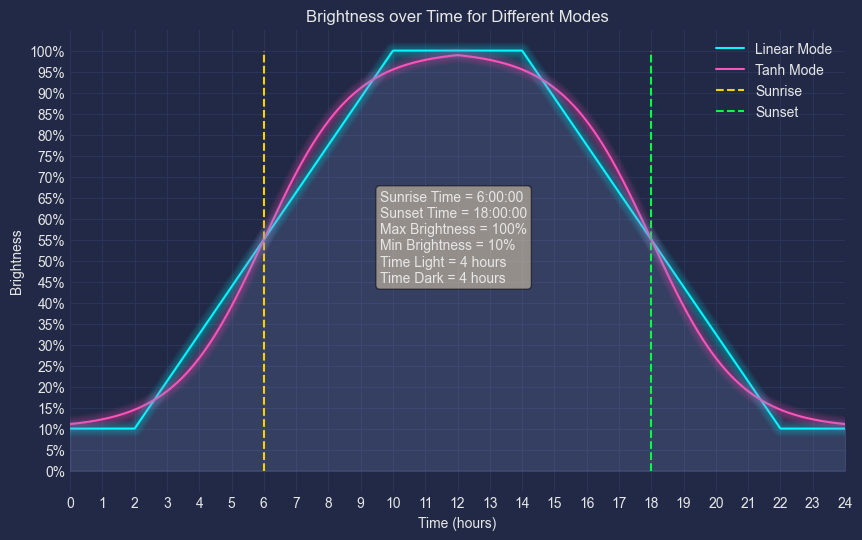
With Adaptive Lighting, you can set a `brightness_mode` to specify how the brightness changes during sunrise and sunset. The `brightness_mode` can be set to `"default"` ([as illustrated in other graphs above](#high_brightness-brightness)), `"linear"`, or `"tanh"`. If you choose to deviate from the `"default"` mode, you can adjust `brightness_mode_time_dark` and `brightness_mode_time_light` to further customize the lighting transitions.
|
|
|
|
When `brightness_mode` is set to `"linear"`:
|
|
|
|
- During **_sunset_**, the brightness begins to gradually decrease from `max_brightness` starting at `time=sunset_time - brightness_mode_time_light`, until it reaches `min_brightness` at `time=sunset_time + brightness_mode_time_dark`.
|
|
- During **_sunrise_**, the brightness begins to gradually increase from `min_brightness` starting at `time=sunrise_time - brightness_mode_time_dark`, until it reaches `max_brightness` at `time=sunrise_time + brightness_mode_time_light`.
|
|
|
|
When `brightness_mode` is set to `"tanh"`, it uses the smooth transition of a [hyperbolic tangent function](https://mathworld.wolfram.com/HyperbolicTangent.html):
|
|
|
|
- During **_sunset_**, the brightness starts to decrease from 95% of `max_brightness` starting at `time=sunset_time - brightness_mode_time_light`, until it reaches 5% of `min_brightness` at `time=sunset_time + brightness_mode_time_dark`.
|
|
- During **_sunrise_**, the brightness starts to increase from 5% of `min_brightness` starting at `time=sunrise_time - brightness_mode_time_dark`, until it reaches 95% of `max_brightness` at `time=sunrise_time + brightness_mode_time_light`.
|
|
</details>
|
|
|
|
Notice the values of `brightness_mode_time_light` and `brightness_mode_time_dark` in the text box.
|
|
|
|
|
|
|
|
|
|
|
|
> Check out the interactive webapp on https://basnijholt.github.io/adaptive-lighting/ to play with the parameters and see how the brightness changes!
|
|
|
|
<!-- OUTPUT:END -->
|
|
|
|
## Configuration Parameters
|
|
|
|
When using `linear` or `tanh` modes, you can fine-tune the transition with these parameters:
|
|
|
|
| Parameter | Default | Description |
|
|
|-----------|---------|-------------|
|
|
| `brightness_mode_time_dark` | 900 (15 min) | Duration to ramp brightness before/after sunrise/sunset |
|
|
| `brightness_mode_time_light` | 3600 (1 hour) | Duration to ramp brightness after/before sunrise/sunset |
|
|
|
|
## Example Configurations
|
|
|
|
### Quick Transition (Linear)
|
|
|
|
```yaml
|
|
adaptive_lighting:
|
|
- name: "Quick transitions"
|
|
lights:
|
|
- light.living_room
|
|
brightness_mode: linear
|
|
brightness_mode_time_dark: 600 # 10 minutes
|
|
brightness_mode_time_light: 1800 # 30 minutes
|
|
```
|
|
|
|
### Smooth Transition (Tanh)
|
|
|
|
```yaml
|
|
adaptive_lighting:
|
|
- name: "Smooth transitions"
|
|
lights:
|
|
- light.bedroom
|
|
brightness_mode: tanh
|
|
brightness_mode_time_dark: 1200 # 20 minutes
|
|
brightness_mode_time_light: 3600 # 1 hour
|
|
```
|
|
|
|
## Graphs
|
|
|
|
These graphs show how brightness changes throughout the day based on calculated values:
|
|
|
|
<!-- CODE:START -->
|
|
<!-- from adaptive_lighting.docs_gen import readme_section -->
|
|
<!-- print(readme_section("graphs")) -->
|
|
<!-- CODE:END -->
|
|
<!-- OUTPUT:START -->
|
|
<!-- ⚠️ This content is auto-generated by `markdown-code-runner`. -->
|
|
These graphs were generated using the values calculated by the Adaptive Lighting sensor/switch(es).
|
|
|
|
### :sunny: Sun Position
|
|

|
|
|
|
### :thermometer: Color Temperature
|
|

|
|
|
|
### :high_brightness: Brightness
|
|

|
|
|
|
### While using `transition_until_sleep: true`
|
|

|
|
|
|
<!-- OUTPUT:END -->
|
|
|
|
## Interactive Simulator
|
|
|
|
The best way to understand brightness modes is to experiment with the interactive simulator:
|
|
|
|
<div style="text-align: center; margin: 2rem 0;">
|
|
<a href="../simulator/" class="simulator-link">
|
|
Try the Simulator
|
|
</a>
|
|
</div>
|
|
|
|
Adjust the `brightness_mode`, `brightness_mode_time_dark`, and `brightness_mode_time_light` parameters to see how they affect the brightness curve in real-time.
|